
Understanding Mental Health Urgent Care: When Therapy Can’t Wait and the ER Isn’t Necessary


Someone’s anxiety level increases on a Tuesday night, but the next time that the person can meet with a therapist is after three weeks. The only other option left for the individual would be to head to a hospital emergency ward which is filled up with gunshot and broken bone injuries. This space lies between “I need help now” and “this is not an actual emergency.
For a long time, that gap just didn’t have a good answer. You waited it out, or you sat in an ER waiting room for six hours next to a stroke patient, feeling like you didn’t belong there. Mental health urgent care centers are here to bridge that gap and let’s be frank, options like Houston urgent depression care have really improved since then.

What Is Mental Health Urgent Care?
Urgent mental health clinics are outpatient facilities designed exclusively to assess and stabilize individuals during an acute psychiatric event. The panic attack that just won’t quit. A depressive crash that’s knocked someone flat. Think of it as the psychiatric equivalent of an urgent care clinic for a sprained ankle – you don’t need the ER, but you can’t wait a month either.
What sets these places apart from a general ER isn’t just the staff, though that matters too. It’s the room itself. Dim lighting instead of fluorescent glare. No monitors beeping. This is a place that is intentionally quiet since it is one way to calm down a highly active nervous system.
A few things you’ll typically find:
Same-day access. Walk in, or book same-day – no eight-week wait for an intake appointment.
Clinical staff who actually specialize in this. Psychiatric nurse practitioners, PAs, licensed counselors – not a general practitioner squeezing you into a fifteen-minute slot between flu shots.
Rapid nervous-system stabilization. Grounding techniques, medication evaluations (non-controlled substances), somatic work – the stuff that actually calms a body down in real time.
A fast read on what level of care you need. Sometimes outpatient stabilization is enough. In some cases, that’s not the case, and it’s the responsibility of the facility to sort it out.
Choosing Urgent Care versus the Emergency Room
It is my most frequently asked question, and the truth is that it all depends on your safety rather than the severity of symptoms.
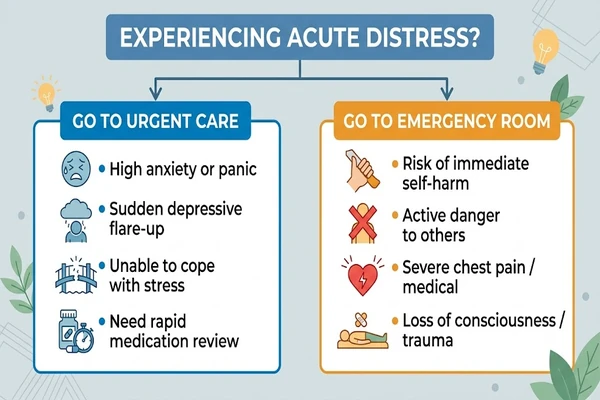
Source : Gemini
Choose urgent mental health care if:
Your anxiety or a panic attack has escalated past what grounding techniques can touch – racing thoughts, shortness of breath, hands shaking, and it’s just not letting up.
You’re in the middle of an acute depressive episode. Overwhelmed, hopeless, barely functioning – but not in physical danger.
You literally cannot get in anywhere else. No psychiatrist has an opening for weeks, and you need a medication review now, not in October.
Something’s happened – a loss, a breakup, a job you got fired from this morning – and the stress has tipped into crisis territory. You need someone to talk you through it today.
Go straight to the ER, or call 911, if:
There’s any immediate risk of harm to yourself or someone else. Full stop, no debate.
You’ve got chest pain, a serious medical complication, or you’re losing consciousness.
Something looks like drug toxicity or severe disorientation. That’s a medical emergency before it’s a psychiatric one.
What Actually Happens During a Visit
Iwill explain all of its components, since “urgent psychiatric care” is a bit of a vague term.
Psychiatric assessment. A nurse practitioner or PA sits down with you and works through what triggered this, when symptoms started, your history, what you need right now. Not a checklist – a real conversation, usually 30 to 45 minutes.
Medication support. If clinical medication makes sense, the provider looks at starting, adjusting, or fine-tuning something non-controlled – SSRIs, SNRIs, that kind of thing. Nobody’s handing out benzos in the waiting room.
Crisis counseling and grounding. This is the immediate work. Regulating the nervous system, catching the cognitive distortions that show up when someone’s in acute distress, getting basic functioning back online enough to get through the rest of the day.
Somatic and neuro-regulatory therapies. Some of the more forward-thinking clinics are folding in things like microcurrent neurofeedback – sub-sensory neurostimulation meant to settle overactive brainwave patterns – along with contrast and thermal therapies designed to bring cortisol and adrenaline back down. Not every clinic offers these yet, but more are adding them.
After You Leave
An urgent care visit isn’t meant to replace real therapy. It’s a stabilization point – the thing that keeps a bad day from turning into a crisis, and buys you time to get connected to something longer-term.
Most people walk out with three things: a short-term follow-up scheduled to check how medication’s landing, a referral to a therapist who does deeper work (CBT, EMDR, DBT – whatever fits), and a concrete plan for what to do the next time things spike at home.
Catch things early, and you stop a lot of ER visits before they ever happen. That’s really the whole case for Houston urgent depression care clinics – not that they replace anything, but that they exist at all.