What Is NUCCA Chiropractic and How Is It Different From a Regular Adjustment? | Draper Spinal Care

If the thought of going to a chiropractor makes you picture someone grabbing your head and twisting until something pops, you’re not alone – and you’re also not entirely wrong about how some chiropractic techniques work. That image is accurate for a number of conventional adjustment styles. It is not accurate for NUCCA, which is the approach used at Draper Spinal Care. The two methods look so different in practice that first-time NUCCA patients often ask if anything actually happened.
Something did. Understanding what, and why it matters, starts with understanding what NUCCA is actually trying to correct.
The Atlas: Why One Small Bone at the Top of the Spine Affects Everything Below It
NUCCA stands for the National Upper Cervical Chiropractic Association. The technique focuses specifically on the relationship between the skull and the uppermost vertebra in the spine – the atlas, also called C1. The atlas is a ring-shaped bone that sits at the base of the skull and supports the weight of the head. It has no intervertebral disc above or below it, which gives it a range of motion no other vertebra in the spine has, and makes it uniquely vulnerable to misalignment.
When the atlas shifts out of its proper position – even by a fraction of a degree – the consequences can travel far beyond the neck. The brainstem, which passes directly through the atlas, is one reason. Subtle pressure or irritation in that area can affect nerve signaling throughout the body. Equally important is the mechanical compensation that occurs below: when the atlas is misaligned, the rest of the spine adjusts to compensate, shifting posture and loading patterns from the cervical spine through the thoracic and lumbar regions all the way to the pelvis.
This is why patients who come in for lower back pain or hip problems sometimes find that the root of the issue is being addressed in their neck. It isn’t magic – it’s mechanics. A foundation that’s off by even a small amount creates imbalances throughout the structure above and below it.
What Makes NUCCA Different From a Conventional Chiropractic Adjustment
Conventional chiropractic adjustments – high-velocity, low-amplitude manipulations – work by applying a quick, controlled force to a spinal joint to restore movement and reduce nerve irritation. The audible pop that accompanies many of these adjustments is cavitation, the release of gas from the synovial fluid in the joint. The technique is widely used, broadly effective for many conditions, and entirely legitimate. It’s also not for everyone.
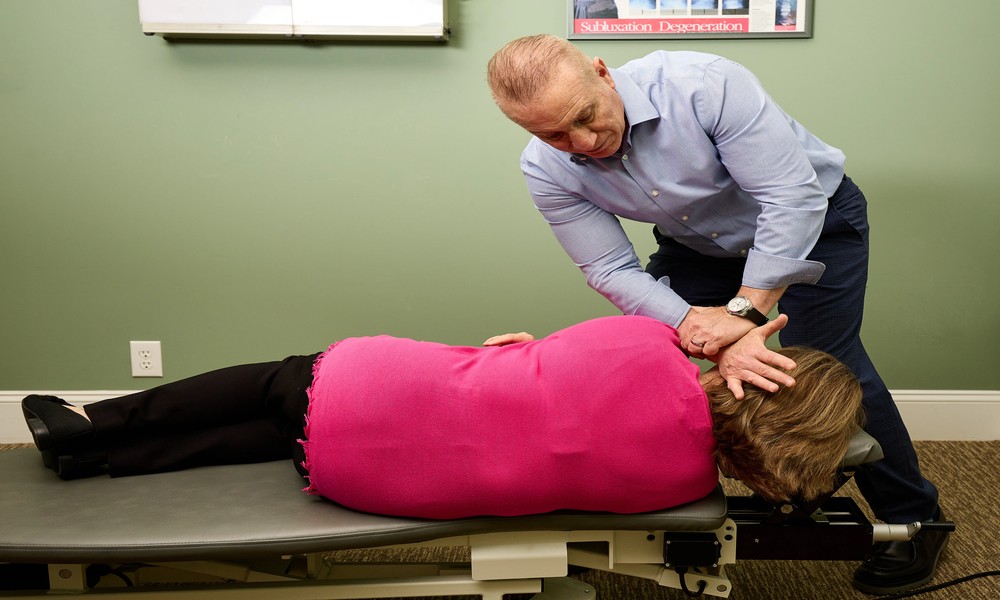
NUCCA operates on a different principle. Instead of applying force to mobilize a joint, NUCCA corrections use a precisely calculated vector of light pressure applied to the atlas – typically through the practitioner’s hand and a specific contact point just behind the ear – to encourage the bone to return to its proper alignment. There is no thrust. No twisting. No audible pop. Patients who’ve never had a NUCCA adjustment sometimes look at the practitioner afterward and ask when the treatment starts.
The specificity is what defines the technique. Before any correction is made, a NUCCA practitioner takes precise X-rays to measure the exact degree and direction of atlas misalignment. The correction is then calculated based on those measurements and applied with a consistency that the practitioner’s training and post-correction imaging are used to verify. It’s a mathematical process as much as a manual one.
That precision matters for a few reasons. Because the correction is calculated rather than generalized, it tends to hold longer than adjustments applied to the general region. Fewer visits are often needed to achieve and maintain correction. And because the technique involves no forceful manipulation of the cervical spine, it’s accessible to patients who have medical reasons to avoid aggressive neck manipulation – including those with certain vascular conditions, previous neck surgeries, or significant osteoporosis.
Who Tends to Respond Well to NUCCA Care
NUCCA is particularly well-suited to patients whose conditions have a structural component that hasn’t responded to other forms of treatment. Common presentations at Draper Spinal Care include:
Chronic headaches and migraines – especially those with a cervicogenic component, meaning the pain originates or is significantly influenced by the upper cervical spine. The atlas’s relationship to the brainstem and vertebral arteries makes upper cervical correction a rational approach for headache patterns that haven’t resolved with medication or conventional care.
Neck pain and whiplash recovery – the atlas is among the most commonly affected structures in whiplash injuries, and its misalignment often persists long after the initial soft tissue healing is complete, contributing to ongoing pain and stiffness.
Dizziness and balance issues – some cases of cervicogenic dizziness, where balance disruption originates from dysfunction in the upper cervical joints rather than the inner ear, respond to NUCCA correction.
Low back pain and sciatica – when the root cause traces back to postural compensation from an upper cervical misalignment, addressing the atlas can produce improvement in lumbar symptoms that lower back treatments alone haven’t resolved.
Patients who’ve had unsatisfying experiences with conventional chiropractic – whether because the force was uncomfortable, the results didn’t hold, or the treatment felt too generalized – also make up a significant portion of NUCCA patients. The approach is different enough that prior chiropractic history, positive or negative, doesn’t reliably predict how someone will respond to NUCCA.
The X-Ray Process and Why It Comes First
One aspect of NUCCA care that distinguishes it from walk-in adjustment models is the emphasis on imaging before any correction is made. At Draper Spinal Care, the initial evaluation includes specialized X-rays taken from multiple angles to measure the position of the atlas in three dimensions. These aren’t standard cervical spine films – they’re taken with the patient in a specific position and analyzed using measurements that inform the correction vector.
That analysis produces a set of numbers: the degree of lateral deviation, the rotation, and the flexion-extension position of the atlas relative to the skull and C2 below. The correction is then tailored to those specific measurements. Two patients with atlas misalignment don’t necessarily receive the same correction, because their misalignment isn’t the same.
Post-correction imaging is used to confirm that the atlas has responded and to assess the quality of the correction. Over time, as the correction holds and surrounding musculature adapts to support the new alignment, the frequency of visits decreases. Many patients transition from active correction to periodic check-ups once they’ve stabilized.
What the Research Says
NUCCA has been the subject of peer-reviewed clinical research, including a notable study published in the Journal of Human Hypertension in 2007 that found atlas correction produced a statistically significant reduction in blood pressure among hypertensive patients – an effect not seen in the sham-adjustment control group. While chiropractic care isn’t a treatment for hypertension, the finding was significant enough to generate considerable attention and further interest in the systemic effects of upper cervical correction.
Research on upper cervical chiropractic more broadly – including NUCCA and related techniques – supports its application in cervicogenic headache, neck pain, and some vestibular presentations. The evidence base is smaller than that for conventional chiropractic given the technique’s relative specialization, but what exists is directionally consistent with what clinicians practicing these methods observe.
The National Upper Cervical Chiropractic Association maintains a research section on its website with published studies for patients who want to review the literature themselves.
Is NUCCA Right for You?
Not every patient who walks through the door at Draper Spinal Care is a candidate for NUCCA care. The initial consultation and examination are designed to determine whether the technique is appropriate for a given patient’s condition, history, and imaging. Patients with certain contraindications, or whose condition would be better addressed through a different modality, are directed accordingly.
For patients who are appropriate candidates, NUCCA offers a specific, gentle, and methodical approach to structural correction that conventional chiropractic doesn’t replicate. If you’ve been hesitant about chiropractic because of concerns about forceful manipulation – or if you’ve tried conventional adjustments without lasting results – it’s worth finding out whether NUCCA is a fit for what you’re dealing with.