
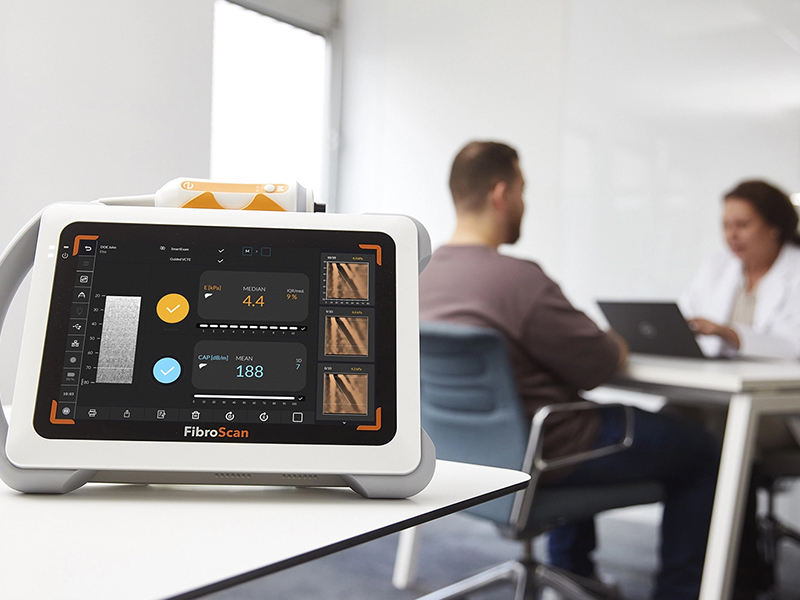
FibroScan testing is a quick and non-invasive imaging technique that measures liver scarring or fibrosis caused by various liver diseases. In addition to evaluating fibrosis, it also quantifies the amount of fat in the liver. The imaging modality offers a non-surgical alternative to the traditional liver biopsy to assess liver damage.
How is a FibroScan performed?
Before the test, your healthcare provider may ask you about your medical history, including any allergies or medications you are taking.
During the procedure, the patient is asked to lie on their back (supine position), and the probe is placed on the skin over the liver area, typically on the right side of the ribcage. The probe sends out sound waves that pass through the skin and bounce back from the liver. These vibrations create a mild sensation but it is generally painless. The sound waves penetrate the skin, tissues and muscles of the abdomen to assess liver stiffness.
Depending on how fast the ultrasound waves pass through the liver, internal liver stiffness, which can be an important indicator of liver scarring and fibrosis due to liver disease, is measured. The liver stiffness offers valuable insights into the extent of liver scarring (fibrosis) and fatty changes in the liver.
If you live in Delhi-NCR, you can know Fibroscan test price by doing an online search.
Is FibroScan the same as an ultrasound?
FibroScan Test is essentially transient elastography, which is an ultrasound-based modality, an enhanced form of ultrasound. It is more sensitive and specific in detecting the presence of fatty liver.
How to prepare for this test?
Your healthcare provider will provide specific instructions to follow before going for the test. Here are some general tips to follow:
• Fasting: Avoid drinking or eating three hours before the exam
• Alcohol: Avoid alcohol at least two weeks prior to the exam
• Clothing: Wear loose-fit clothing as your abdominal area needs to be exposed during the procedure
• Health concerns: If you have difficulty lying on your back, inform your healthcare provider before the test, so that necessary adjustments can be made
Why do you need this test?
Your doctor may order this test to help evaluate or monitor the progression of diseases affecting the liver, including:
• Non-alcoholic fatty liver disease (NAFLD): NAFLD leads to abnormal build-up of fat in the liver cells, thus increasing the risk of liver damage.
• Alcoholic liver disease (ALD): ALD occurs when an individual drinks more alcohol than the liver can process, causing inflammation and, in turn cirrhosis, also known as alcoholic hepatitis.
• Non-alcoholic steatohepatitis (NASH): NASH is a more severe form of NAFLD and is progressive in nature, possibly leading to fibrosis, cirrhosis and liver failure.
• Viral Hepatitis: Hepatitis B virus (HBV) or the Hepatitis C virus (HCV) can cause liver inflammation and damage to the liver, putting an individual at increased risk of developing cirrhosis or liver cancer or of suffering from liver failure.
• Hemochromatosis: This condition leads to excessive build-up of iron in the body, including the liver, causing toxicity in the body and leading to liver damage.
The FibroScan liver test can also be used to monitor liver health for patients following liver transplantation.
Disclaimer: For personalised advice and further information, always consult your doctor or qualified healthcare professional.